2,4-D
Silent Spring2,4-D is a widely used herbicide in Rachel Carson’s account of the reach and uncertainty of chemical control. Its significance lies in the distance between its familiar use against unwanted plants and the less visible processes it may disturb: soil nitrogen cycling, plant metabolism, cellular respiration, and chromosomes. The book treats it not as an isolated lawn or field treatment but as part of a wider history in which persistent chemicals enter landscapes, water, food, and living bodies, while evidence of their effects accumulates unevenly.
Use and Environmental Reach
The most widely used herbicides, Carson writes, include 2,4-D, 2,4,5-T, and related compounds. Their toxicity was controversial, but the manner of application mattered: unlike broad broadcasting, some vegetation treatments concentrated chemicals at the base of trees, a method that could keep potential harm to wildlife to a minimum. That distinction makes application practice part of the account, not a technical footnote; the chemical’s risks depend partly on where and how it is placed.
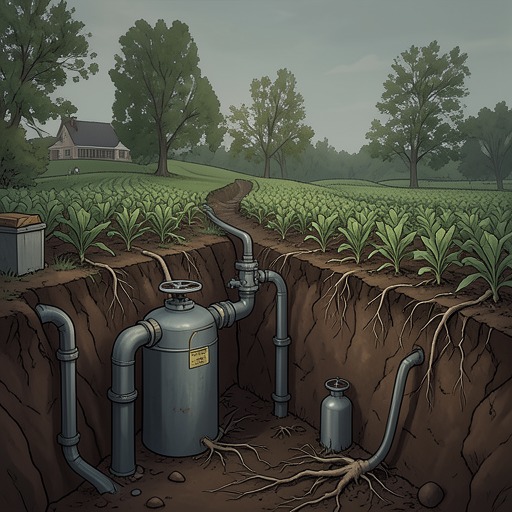
The book also connects 2,4-D with contamination extending beyond a treated plot. At the Rocky Mountain Arsenal, investigators found it in wells and holding ponds. The discovery was especially troubling because seepage had continued to spread into an area of unknown extent, and investigators knew no way to contain the contamination or stop its advance. The herbicide’s presence was described as mysterious and potentially among the episode’s most significant features. Here the issue is not only a chemical’s intended action on vegetation, but its movement into water and the difficulty of controlling it once it has escaped its point of use.
Effects on Soil and Plants
2,4-D can temporarily interrupt nitrification, the process by which atmospheric nitrogen becomes available to plants. Carson places this finding among pesticide effects on the chemical transformations at the heart of living systems. Experiments in Florida also found that lindane, heptachlor, and BHC reduced nitrification after only two weeks in soil, setting the herbicide’s effect within a broader pattern of chemicals interfering with basic soil processes.
Treatment can alter a plant’s metabolism in ways that change its value to animals. After 2,4-D application, sugar content temporarily rises, making the plant more attractive to many animals. The chemical may therefore affect not only the treated vegetation itself but also the feeding relations that follow from a change in its composition.
Another reported change concerns nitrate. Experiments conducted about a decade before Carson’s account showed a sharp increase in nitrate content in corn and sugar beets after treatment with 2,4-D. The finding matters because a herbicide’s consequences can travel through the plants people and animals consume; the book presents the altered crop chemistry as a concern for livestock, wildlife, and people, not merely as a botanical response.
Cellular and Reproductive Concerns
Carson describes evidence that 2,4-D can disturb cellular respiration and imitate X-rays in damaging chromosomes. These effects belong to a different scale from the visible injury or control of plants: they concern fundamental processes within cells. She also reports that medical authorities advised caution after people whose skin became wet with lawn spray occasionally developed severe neuritis and even paralysis. Such incidents were apparently uncommon, and the toxicity of the compounds remained disputed; the account therefore records the human hazards without presenting every reported consequence as settled or frequent.
The discussion of chromosomes returns in the book’s account of mutagenic effects. In plants treated with 2,4-D, tumorlike swellings appeared; chromosomes became short, thick, and clumped together, and cell division was seriously retarded. The general effect was said to closely parallel that produced by X-rays. Carson emphasizes that these examples did not amount to a comprehensive study of the mutagenic effects of pesticides as a class. The force of the evidence lies both in the observed abnormalities and in the acknowledged gap in systematic testing.
Possible effects on reproduction broaden the concern further. Carson notes that recent work indicated bird reproduction might be adversely affected by 2,4-D and related compounds. This is presented as a warning emerging from research, not as a quantified account of population decline. In the book’s wider argument, however, the possibility links cellular damage to consequences beyond the treated plant and makes the limits of knowledge part of the public risk.
A Chemical Within a Wider Pesticide Debate
The book places 2,4-D among herbicides that can uncouple oxidative phosphorylation, a disruption of the cellular process through which energy is made usable. DDT is identified as a proven uncoupler, while the possibility that further study would reveal others among the chlorinated hydrocarbons remains open. The comparison does not make all these chemicals interchangeable; it shows how the same broad agricultural program could involve substances acting through different mechanisms, and why scrutiny of one effect or one application could not stand in for a full assessment.
That demand for scrutiny shaped Carson’s own work. In 1958, at age fifty, she began the book that became Silent Spring, after a career as a marine biologist and writer with the U.S. Fish and Wildlife Service. She and scientific colleagues had become alarmed by the widespread use of DDT and other long-lasting poisons in agricultural control programs. When she tried to interest magazines in an article about the dangers, publishers feared losing advertising; a canned baby-food manufacturer objected that such an article would cause unwarranted fear among mothers. The dispute over 2,4-D belongs within that larger contest over what pesticide effects should count as public knowledge: evidence could concern distant contamination, slow biological changes, or uncertain hazards, while commercial and institutional pressures shaped whether those concerns reached readers.
Significance
2,4-D’s role in Carson’s argument is cumulative rather than dependent on a single dramatic poisoning. The herbicide appears in evidence about water contamination, soil nitrogen, crop chemistry, cellular respiration, chromosome damage, and possible effects on bird reproduction. Each finding has its own limits and conditions, but together they challenge the assumption that a chemical’s effects end with its intended target. A treatment applied to vegetation may alter the soil beneath it, the plants made available to animals, and biological processes too small to see directly.
The account also insists on distinctions: concentrated application can reduce wildlife exposure compared with broadcasting; some human incidents are uncommon; some effects are experimental; and comprehensive testing of pesticide mutagenicity was lacking. Those qualifications do not erase the warning. They show why a chemical with disputed toxicity and incompletely studied effects cannot be judged solely by its immediate success as a herbicide. In Carson’s presentation, 2,4-D makes visible the central problem of chemical control: the intended act is local, but the pathways of exposure and consequence may not be.